Why Python?
I wrote the title of this article, and I had an outline of all the reasons I personally love Python. But when I sat down to write the article itself, I had a flashback to browsing the internet during the school holidays, looking for something innovative to pitch as a six-month elective. I thought about the types of questions teachers have when trying to choose learning domains that balance engagement, success, curriculum, allotted time and, most importantly, the cohort of students they will be teaching. And so, from that perspective, I asked myself: what are the questions teachers will be asking when deciding on a programming language?
- Is it easy enough for my students and me to learn?
- Are there lots of learning materials for this language?
- Can I do something really fun and engaging with this?
- When kids ask, "Why are we learning this?", will I have a good answer?
Now I am going to try to answer all of these.
1. Is it easy enough for my students and me to learn?
I have spent seven years teaching Python and about four running Python workshops and PD for teachers. My feeling was always that it was easy to have some success early, which tends to build momentum. However, the reality of most programming languages is that concepts build on one another. As soon as we progress to a moderate level of complexity, there are half a dozen concepts interacting, and any misconceptions that students may have compound quickly.
So, basically, teachers need to cover the basics again and again until mastery is reached. This is why Agent Games' flagship course, Python Fundamentals, covers each concept at least three times, with the fundamental concepts being covered about eight times on average (see the concept map).
2. Are there lots of learning materials for this language?
OMG, yes! Type "learn Python" into Google, and you will be spoilt for choice. As a teacher, my main stop was W3Schools. However, with the advent of AI, as an experienced Python programmer, I can tell you that the latest Claude 5.5 and ChatGPT 6 models are all really good at it. When requested, they can explain concepts at a high-school level.
In Australia, teachers have free access to Grok Academy, which offers courses written primarily in Python. It's worth mentioning that I used to teach with Grok and worked there for 18 months. Given this abundance, I have designed Agent Games to copy what works for 70% of the content (exercises and interactive lessons). I turned the last 30% into more open-ended, high-ceiling, fun games where each student can proceed according to their ability.
3. Can I do something really fun and engaging with this?
Let me list some fun things that I did in the classroom using Python:
- micro:bit drones that students built from a kit and programmed to fly using Python.
- Recommendation engines where students built programs that quizzed an audience about movies or video games and produced recommendations.
- 2D games with Pygame, like Space Invaders, Snake and platformers.
- 3D games with the Ursina Game Engine.
- Cybersecurity challenges like codebreaking and demonstrating how passwords can be hacked and why we need longer, more complex passwords.
- Maths games: one of my very first Python programs in the classroom was called Probability Pokémon, created during the Pokémon Go craze. Pokémon appeared on a grid based on equations that involved probability, and kids set traps for them.
- Finally, Agent Games, the platform you are on, is written in Python, which does the heavy lifting on the back end, with React.js on the front end.
4. When kids ask, "Why are we learning this?", will I have a good answer?
Oh yes, absolutely!
First of all, the chart below, from the GitHub Developer Survey, shows you what programmers are building the world's software with. And the answer is predominantly JavaScript and Python, with the role of JavaScript being to make things look pretty in the browser and Python doing pretty much everything else!
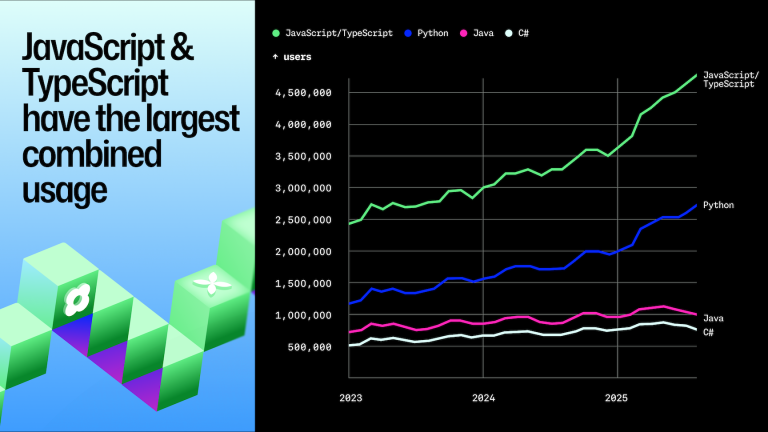
Sourced from the GitHub Developer Survey.
But it's not just programmers. If you go to PyCon, you will find that programmers are about half the audience, with the other half being made up of scientists and educators. As science advances, it becomes more and more about data analysis, and most tools for this are built in Python. The same case can be made for finance, but that is a more secretive industry, which does not share as much as the ones I mentioned.
Teacher comments
No comments yet.
🛡️Comments are restricted to teachers only and moderated for child safety reasons.